2. Preprocessing & Process Discovery Configuration
Preprocessing and process model generation are executed automatically after Log Import using a default configuration. Alternatively, the process can be re-triggered using a custom configuration defined in this step. After submitting the configuration form, the log is reprocessed. The resulting Process Models can then be viewed in the next step.
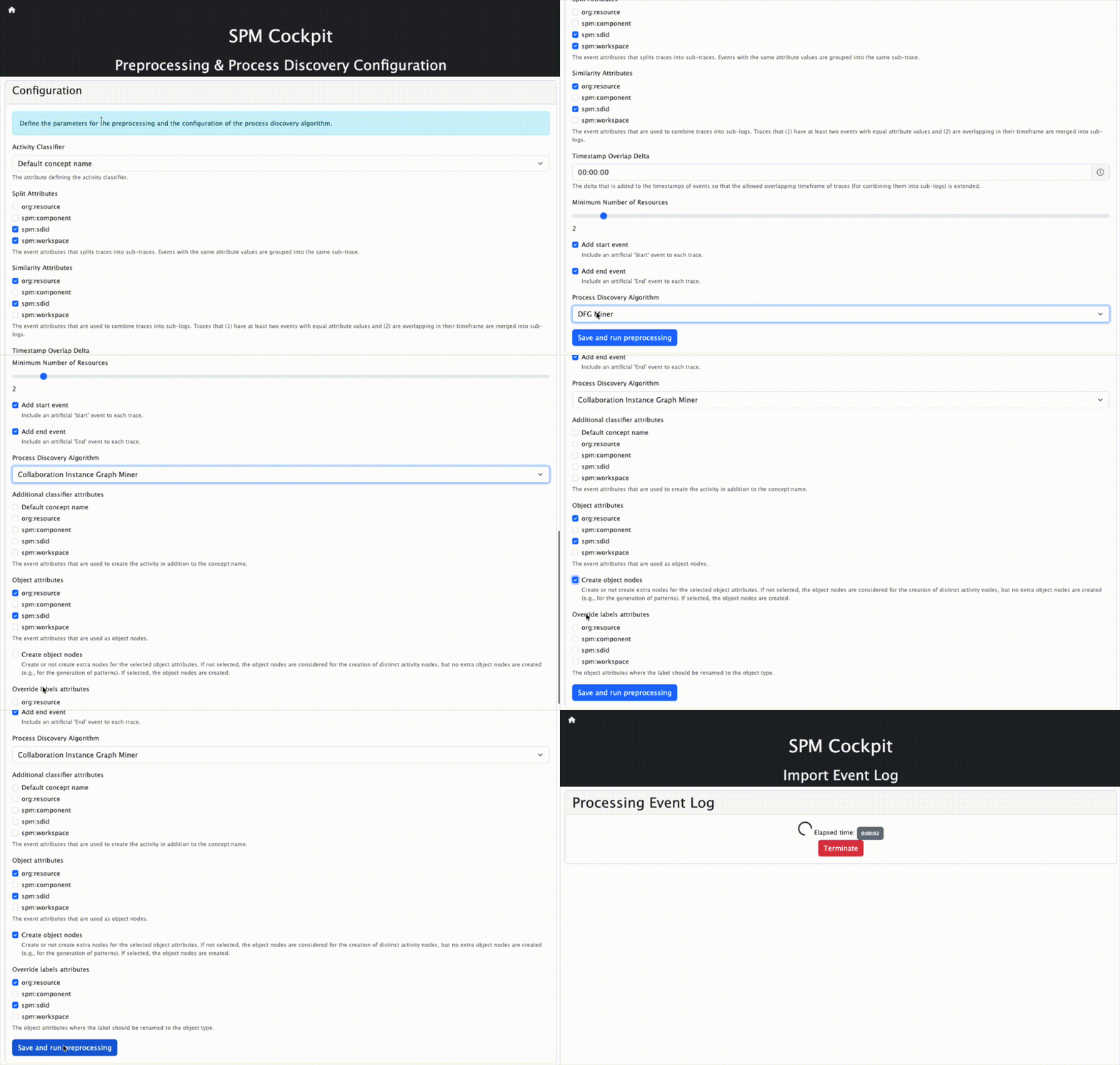
Configuration
This form defines custom parameters for the preprocessing and the process discovery algorithm.
Preprocessing
Split attributes
The Split Attributes are used to split each original trace into multiple traces, which are then used to create sub-logs.
For example, a trace containing three social documents (spm:sdid) is split into three separate traces if spm:sdid is used as a split attribute.
Similarity attributes
The Similarity Attributes define event attributes used to merge traces into sub-logs.
Traces are merged into sub-logs if they (1) have at least two events with identical attribute values and (2) overlap in their timeframe.
Timestamp overlap delta
This delta is added to event timestamps to extend the allowed overlapping timeframe for merging traces into sub-logs.
Minimum Number of Resources
Specifies the minimum number of resources n; any sub-log with fewer than n resources is discarded.
Artificial start and end activities
Artificial start and end events can be added to each trace within a created sub-log.
For example, the case A->B->C becomes Start->A->B->C->End.
This behavior can be configured.
Process discovery
Currently, the Collaboration Instance Graph Miner (default), the DFG-Miner, or the Heuristic-Miner can be selected for process instance model discovery.
For the Heuristic Miner, parameters such as Dependency Threshold, And Threshold, and Loop Two Threshold can be configured [1].
[1] For details see Weijters, A. & Aalst, Wil & Medeiros, Alves. (2006). Process Mining with the Heuristics Miner-algorithm.
Note
The Collaboration Pattern Detection Framework uses the pm4py library for the discovery algorithms.
Collaboration Instance Graph Miner
The Collaboration Instance Graph Miner is an extension of the DFG Miner that enables the discovery of collaboration patterns by focusing on interactions between resources and objects. Key features include:
- Activity Classifiers: Allows specifying additional attributes that augment activity labels.
- Relation (Object) Attributes: Specifies attributes used to define relations between activities and objects.
- Object Node Creation: Optionally creates dedicated nodes for objects in the resulting graph.
- Label Overrides: Provides the ability to override labels of relation attributes with the name of the attribute type (e.g., "org:resource").